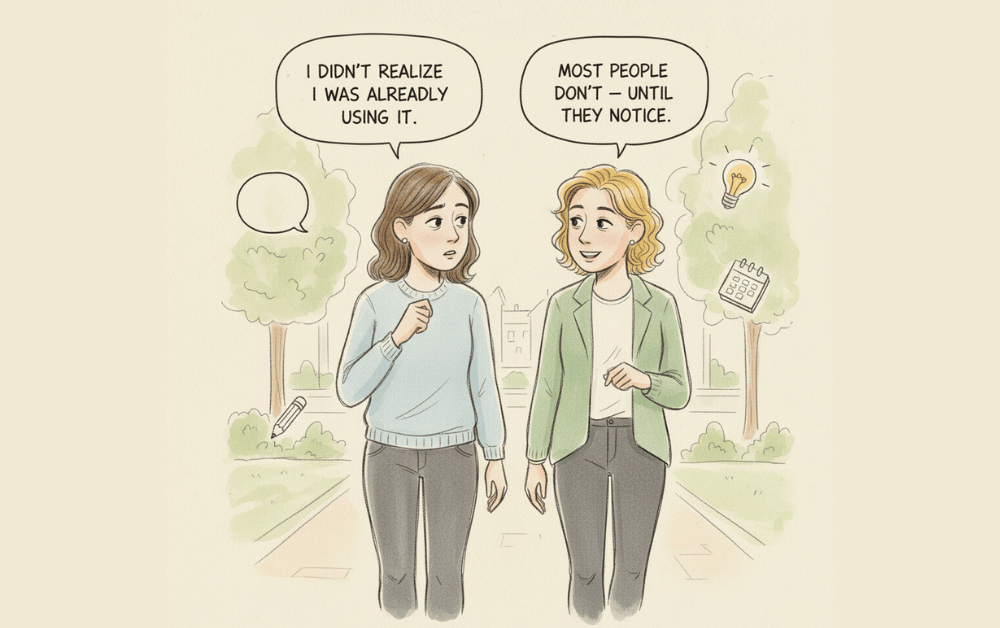
After learning what AI tools actually are, the next question I found myself asking was simple:
how are people really using them in everyday life?
Not in headlines. Not in dramatic predictions. But in quiet, ordinary moments.
Once I started paying closer attention — and using these tools myself — I realized that AI wasn’t something waiting in the future. It was already woven into daily routines in ways that felt practical rather than revolutionary.
How I See People Using AI for Writing and Communication
The most common use I’ve noticed is writing assistance.
I don’t see most people handing over full control to AI. Instead, they use it to help say what they already mean — just more clearly. That might look like rewriting an email to sound more professional, softening the tone of a difficult message, or fixing grammar when words don’t come easily.
For non-native English speakers, this seems especially empowering. I’ve seen how AI can remove some of the anxiety around being misunderstood, without taking away someone’s voice. It doesn’t replace their thoughts — it helps shape them.
Personally, I’ve also used AI during moments when I felt stuck. Not to finish my work for me, but to help me move past the blank page.
How I See AI Being Used for Creativity and Ideas
In creative spaces, AI is often misunderstood.
From what I’ve observed — and experienced — creatives aren’t using AI to replace imagination. They’re using it to get unstuck.
I’ve seen artists and writers use AI to explore visual styles, generate rough concepts, or test ideas quickly. Instead of spending hours imagining every possible direction, AI lets them see options fast — and then decide what actually feels right.
The creative decision-making still belongs to the human. AI just widens the doorway.
How AI Shows Up in Work and Productivity
At work, the role of AI feels less dramatic and more practical.
People I know use AI to summarize long documents, pull key points from meetings, or organize scattered thoughts. What stands out to me is that AI doesn’t replace their responsibility — it reduces the mental clutter around it.
I’ve noticed that when repetitive tasks become easier, people have more energy for judgment, creativity, and actual thinking. In that sense, AI doesn’t change what people do — it changes how drained they feel while doing it.
How People Use AI to Learn and Understand Things
One of the uses that surprised me most was learning.
I’ve seen people turn to AI as a kind of private tutor — asking questions they might feel uncomfortable asking elsewhere. They use it to break down complex topics, ask follow-up questions, or get explanations tailored to their level.
What I like about this is the lack of pressure. There’s no embarrassment in asking something twice. Learning becomes slower, gentler, and more personal.
How I See AI Used for Conversation and Companionship
This is one of the most sensitive areas, and one I think deserves care.
Some people use AI for conversation not because they want to replace human connection, but because they want a low-pressure space to talk. I’ve seen it used for emotional reflection, practicing communication, or simply having a place to express thoughts out loud.
For people dealing with loneliness, anxiety, or isolation, this kind of interaction can feel comforting. That doesn’t mean it should replace real relationships — but I don’t think it should be dismissed outright either.
This is an area where boundaries, ethics, and self-awareness matter a lot, and it’s something I plan to explore more deeply.
What I Don’t See People Using AI For
Despite all the fear around AI, I don’t see most people:
- Letting AI make major life decisions
- Trusting AI without question
- Using AI without their own judgment involved
In real life, people are cautious. They double-check, they question outputs, and they use AI as one input among many — not as a final authority.
A Pattern I’ve Noticed Over Time
Across all these everyday uses, one pattern keeps showing up for me:
AI tools work best when they support human thinking, not replace it.
When people expect AI to do everything, it often disappoints them. When they treat it like a tool — something to assist, not lead — it becomes genuinely useful.
That mindset shift made all the difference for me too.
Where This Leads Next
Understanding how people use AI tools in daily life helped me see why certain AI categories exist — especially more personal ones like AI companion apps.
Those tools bring up deeper questions around connection, ethics, and emotional boundaries, and they deserve a closer look.
If you’re curious about this side of AI, I’ve written a deeper piece on AI companion apps and why people are using them.