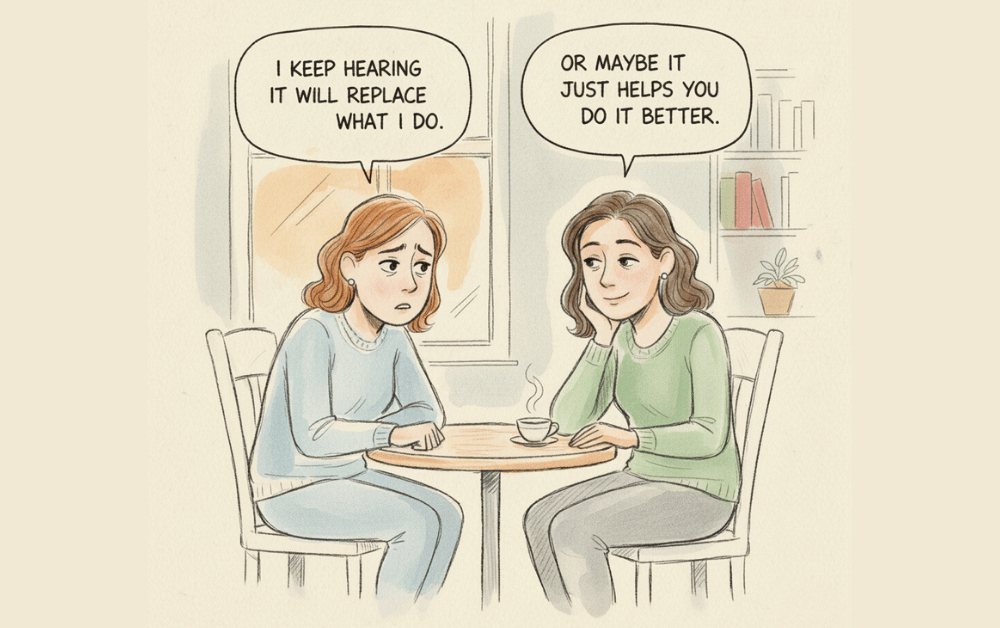
I didn’t start learning about AI because I was excited.
I started because it was suddenly everywhere — in headlines, at work, in conversations — and I felt like I was supposed to have an opinion about it before I’d even had time to understand it.
Most explanations I found were either overly technical or unnecessarily alarming. Some made AI sound like magic. Others made it sound like an existential threat. Neither helped me feel grounded.
So I decided to slow down and ask a simpler question: What are AI tools, really — in practical, human terms?
What are AI Tools?
When people talk about AI tools, they’re usually referring to software that can analyze patterns, generate responses, or assist with tasks that would normally require human input.
That sounds abstract, but in practice, it’s much simpler.
AI tools don’t “think” or “understand” the way humans do. They don’t have intentions or awareness. What they do have is the ability to process large amounts of data and respond based on patterns they’ve learned.
In other words, AI tools are systems trained on information, not beings with judgment or consciousness.
That distinction matters more than most people realize.
Why AI Tools Feel So Different From Other Software
What initially unsettled me wasn’t the technology itself — it was how human some interactions felt.
Traditional software does exactly what it’s told. AI tools, on the other hand, can:
- Respond in natural language
- Adapt based on previous input
- Generate new combinations of ideas
That responsiveness creates the illusion of intelligence.
But illusion isn’t the same as intention.
Once I understood that AI tools don’t know what they’re saying — they’re predicting what comes next based on patterns — my fear softened into curiosity.
The Types of AI Tools I Started Noticing First
I didn’t encounter AI tools all at once. They showed up gradually, in everyday places.
Writing and Content Tools
These were the first ones I noticed. Tools that help draft text, summarize information, or rephrase ideas.
What surprised me was that they didn’t replace thinking — they often required more clarity. The better the input, the better the output. That made me see them less as replacements and more as collaborators.
Image and Design Tools
Next came AI-generated images and visual tools.
At first, I worried they would erase creativity. But over time, I noticed something else: people were still guiding the process. The tool didn’t imagine — it responded. The creativity was still human; the execution was assisted.
Chat-Based Tools
These felt the most confronting.
Talking to something that answers back in full sentences triggered all sorts of emotional reactions — fascination, discomfort, curiosity. It was here that I realized how easily humans project meaning onto responsiveness.
The tool wasn’t listening — but it felt like it was.
What AI Tools Are Actually Good At
From what I’ve seen, AI tools are best at:
- Handling repetitive or structured tasks
- Generating drafts or starting points
- Organizing or summarizing information
- Assisting brainstorming when you feel stuck
They’re efficient, fast, and surprisingly useful when used intentionally.
But they’re not wise. They don’t understand nuance unless it’s been modeled. And they don’t know when something matters emotionally unless we tell them.
Where AI Tools Fall Short (And Why That’s Important)
This part often gets glossed over.
AI tools can sound confident while being wrong. They can reflect biases present in their training data. They can generate convincing responses without understanding truth, ethics, or consequences.
Realizing this helped me stop expecting too much from them.
AI tools don’t replace:
- Critical thinking
- Emotional intelligence
- Moral judgment
- Human responsibility
And they shouldn’t be asked to.
Why People Feel So Strongly About AI (On Both Sides)
What I’ve noticed is that reactions to AI tools often say more about human fears and hopes than about the technology itself.
Some people fear loss — of jobs, creativity, meaning.
Others feel excitement — about efficiency, access, and possibility.
Both reactions are understandable.
AI tools sit at an uncomfortable intersection: they reflect us, but without being us. And that forces people to confront questions about value, identity, and purpose.
How I Personally Think About Using AI Tools
For me, AI tools are just that — tools.
They work best when:
- I stay aware of their limits
- I remain responsible for outcomes
- I don’t outsource thinking entirely
- I treat them as assistants, not authorities
Used this way, they become helpful rather than intimidating.
Why I Think Learning About AI Slowly Is Okay
There’s a lot of pressure to “keep up.”
But understanding AI tools doesn’t require urgency — it requires clarity.
You don’t need to adopt everything. You don’t need to have a strong opinion right away. Curiosity is enough.
That’s how I started, and it made all the difference.
In the next article, I’ll share how people are actually using AI tools in everyday life, with real examples and use cases.